Our Solutions
Data In Motion develops modular, model-driven open source software solutions for organisations navigating complex data governance, compliance, and integration challenges — designed to integrate into existing system landscapes rather than replace them. Automation accelerates repetitive, error-prone tasks, while human decision-makers retain full control at every consequential step.
All solutions are built on open-source components actively developed and maintained by Data In Motion. Designed around modularity, open standards, and composability, each component can be adopted independently or combined with others — tailored to specific requirements, without architectural constraints or vendor dependencies.
Technology Foundation
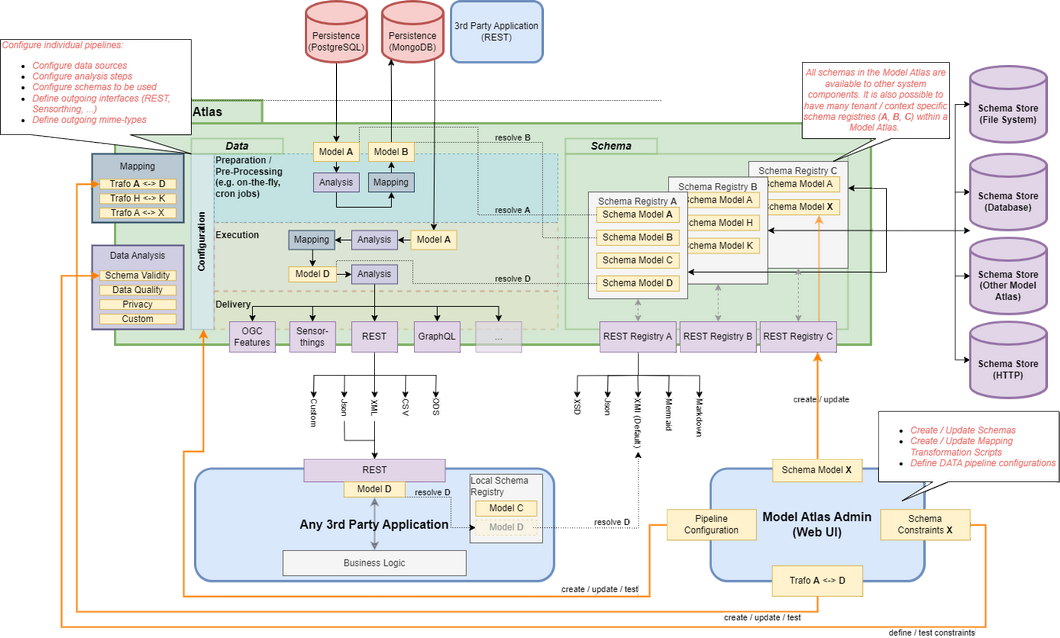
Model Atlas
The following demo illustrates the Model Atlas data flow — from schema ingestion across multiple source formats to the model registry and downstream distribution to connected applications.
Our Model Atlas Technology provides a universal, modular, and expandable framework for data management. At its core is a powerful set of tools for model creation and ingestion. We utilize AI to generate models from various input formats, read models directly from SQL schema descriptions, and import from standards like JSON-Schema, XSD, and OpenAPI. This flexibility makes it a key enabler for connecting data from various sources with distributed applications.
Key capabilities:
- Web-based EMF Model Registry & Multi-Tenancy
- Extendable governance analysis and validation
- Pluggable model output formats (XMI, XSD, Json-schematics)
- Automatic documentation generation (PlantUML, ODS, etc.)
- DCAT / RDF Support for Open Data or Dataspace registries
- Client adapter for model discovery (EMF Java, TypeScript, Python)
The Adapter Layer
The Model Atlas integrates into virtually any distributed software architecture. The adapter and codec library covers the following connectivity categories, allowing existing system landscapes to be connected without middleware replacement:
- Databases: Relational Databases (via JDBC), MongoDB
- Messaging & Streaming: Apache Kafka, Apache Camel
- Storage & Search: S3/Minio, Apache Lucene
- APIs: Deep integration for REST with Jakarta RESTful Web Services (we are currently working on a generic OpenAPI client)
- IoT: Deep integration into the sensiNact IoT Broker
- Transformation & Serialization: Powerful transformation adapters (QVT) and a highly adaptable codec based on Jackson for numerous serialization formats
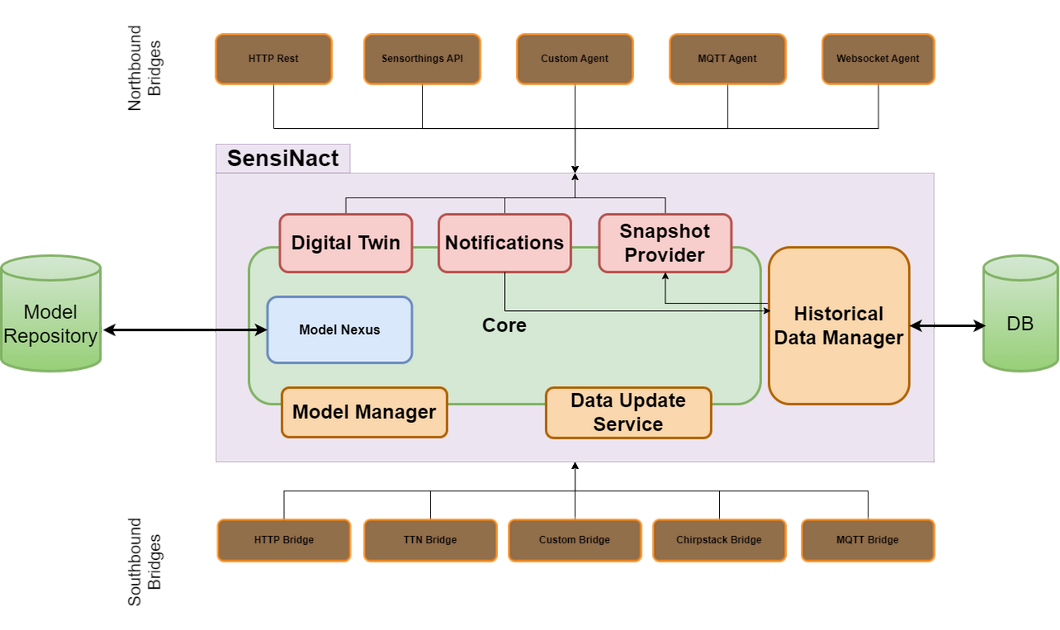
SensiNact: IoT Integration Broker
Eclipse sensiNact is an open-source IoT broker that normalises heterogeneous device access, data, and metadata into a unified information model — enabling smart applications to manage and query IoT devices regardless of their underlying technology. Data In Motion are active committers to the project and offer development services including custom protocol adapters.
- Protocol breadth: Native support for LoRa, Zigbee, IEEE 802.15.4, Sigfox, enOcean, MQTT, XMPP, NGSI, HTTP, CoAP, and more. New protocols can be developed and loaded dynamically at runtime without service interruption.
- Deployable at any tier: Runs as a lightweight edge node, a local gateway, or a cloud-level integration hub — keeping data processing close to the source while connecting upstream via OGC SensorThings, REST, or WebSocket northbound APIs.
- Formal data and service models: EMF-based Provider-Service-Resource hierarchy ensures reliable adapter development for niche protocols and runtime consistency across diverse IoT environments.
Policy & Governance Engine
At the core of our analysis capabilities is a powerful governance engine. Its origins lie in our Model-Driven Privacy Analyzing Tool (MPAT), but it has evolved into a versatile solution for enforcing a wide range of policies.
The engine operates at both the model level (design-time analysis of schemas) and the instance level (run-time analysis of actual data). Its rules are not hard-coded; they are defined in adaptable “Policy Packs” (e.g. for GDPR, ISO 27001, EU AI Act, Cyber Resilience Act, ESG Reporting Frameworks), allowing for customized and extensible governance. Furthermore, the engine can validate policies against the declared capabilities of your infrastructure components (assets), ensuring that technical reality aligns with regulatory requirements.
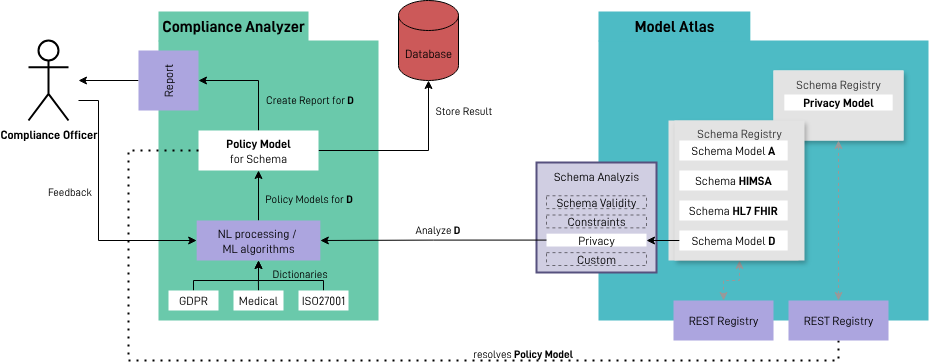
Check process on model level (analyzing the schema design)
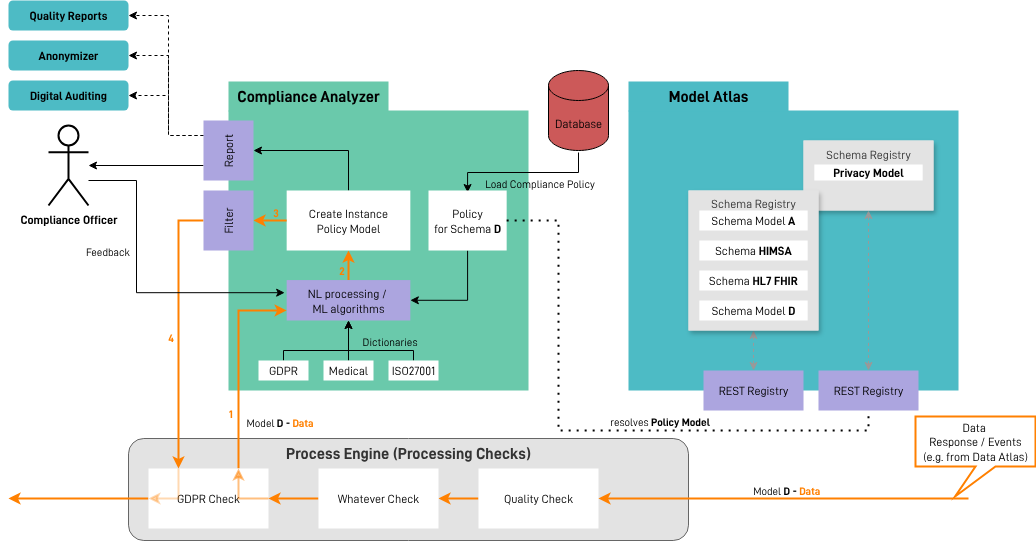
Check process on instance level (analyzing the actual data)
Digital Notary
The Digital Notary is a key component for creating verifiable trust in digital processes. Based on blockchain technology, it provides a tamper-proof, immutable log of all governance-related events. Every significant action - from approval of a data model by a Data Steward to the result of an automated compliance check - is cryptographically sealed and chained. This creates a complete and trustworthy audit trail that can be presented to auditors or regulators at any time, providing conclusive proof that all defined processes and policies have been adhered to.
MCP Server & AI Integration Layer
The MCP Server (Model Context Protocol) exposes the full knowledge stock held in the Model Atlas — governance models, data lineage, technical documentation, domain schemas, regulatory documents, and audit history — as structured, typed tool endpoints callable by any LLM. Unlike generic document retrieval, responses are grounded in formally typed Ecore models, enabling queries that combine static domain knowledge with live operational state.
Key integration points:
- Document ingestion: Apache Tika (PDF, Word, Confluence, HTML, plain text)
- Embeddings: Voyage-AI (1024 dimensions), configurable for alternative providers
- Vector search: Lucene KNN indexing — same search engine as the model registry; no additional vector database required
- Protocol: Model Context Protocol (open standard); tested with Claude, OpenAI-compatible APIs, Gemini, and self-hosted models (Ollama, vLLM)
- Access control: Tool endpoints honour the same Keycloak RBAC policies as the REST API — an LLM session operates within the permissions of the authenticated user
- Auditability: All LLM-generated outputs can be routed through the standard governance workflow before taking effect, with full audit trail via the Digital Notary
In Practice
A selection of deployments where our technology runs in production. Several of them are located in Jena — where Data In Motion is based and where improving the city’s data infrastructure is a goal we share as residents and as a company.
Environmental Sensor Data Integration + Model UI
This demo shows the no-code dashboard for environmental sensors — illustrating the plug-and-play integration path from LoRaWAN device to the configurable visualisation layer.
We provide a ready to deploy setup for integration, management and an end user friendly analyzing dashboard that is capable of visualizing sensor data in an highly customizable no-code interface. The showcase example demonstrates the customization experience on the dashboard with several soil moisture sensors, which can be added and integrated via plug&play.
Smart Traffic Data System
This demo shows the TraffiCam system ingesting live traffic signal phases and sensor inputs from a real intersection and making them available as a structured data stream.
With our Traffic Signal Detection System, we provide a solution to connect traffic light systems into smart city infrastructures. By using an easy-to-maintain hardware setup, we make traffic light phases and sensor inputs readable and transferable in real time. This solution enables municipal operators to access monolithic traffic light systems, which are often equipped with proprietary software. The collected real time traffic data can be used to implement smart switching systems into existing infrastructure without having to procure new traffic control technology (e.g. making it SUMO ready). By pairing this data with streams from other data sources like traffic cameras, we offer a comprehensive data suite for facilitating real time traffic monitoring or enabling smart traffic control solutions, with nearly endless use case combination possibilities.
Traffic Conflict Detection
This demo shows the real-time conflict detection system combining traffic signal state and sensor streams to predict potential road conflicts before they occur.
Our technology is successfully used to manage complex real-time scenarios. By combining data from various sources (sensors, signal systems), we can predict potential conflicts in road traffic in real-time - a use case that requires highest standards of real-time data quality, security, and traceability.
Work With Us
Whether your starting point is data governance, infrastructure visibility, AI integration, or a data platform — we work with organisations to design and implement solutions based on these components. Contact us to discuss your use case.